Digital Business Card with QR Code: The Complete Guide to Modern Networking, vCards, and Professional Contact Sharing
The way people exchange business information has changed significantly. A few years ago, exchanging contact information usually meant handing someone a printed business card. Today, people expect information to be available instantly on their smartphones. Customers want to find businesses online, professionals want to connect through LinkedIn or WhatsApp, sales teams want to follow up quickly, and companies want their employees to have a consistent and professional digital identity.
This is where a digital business card with a QR code, commonly known as a digital vCard, becomes extremely useful.
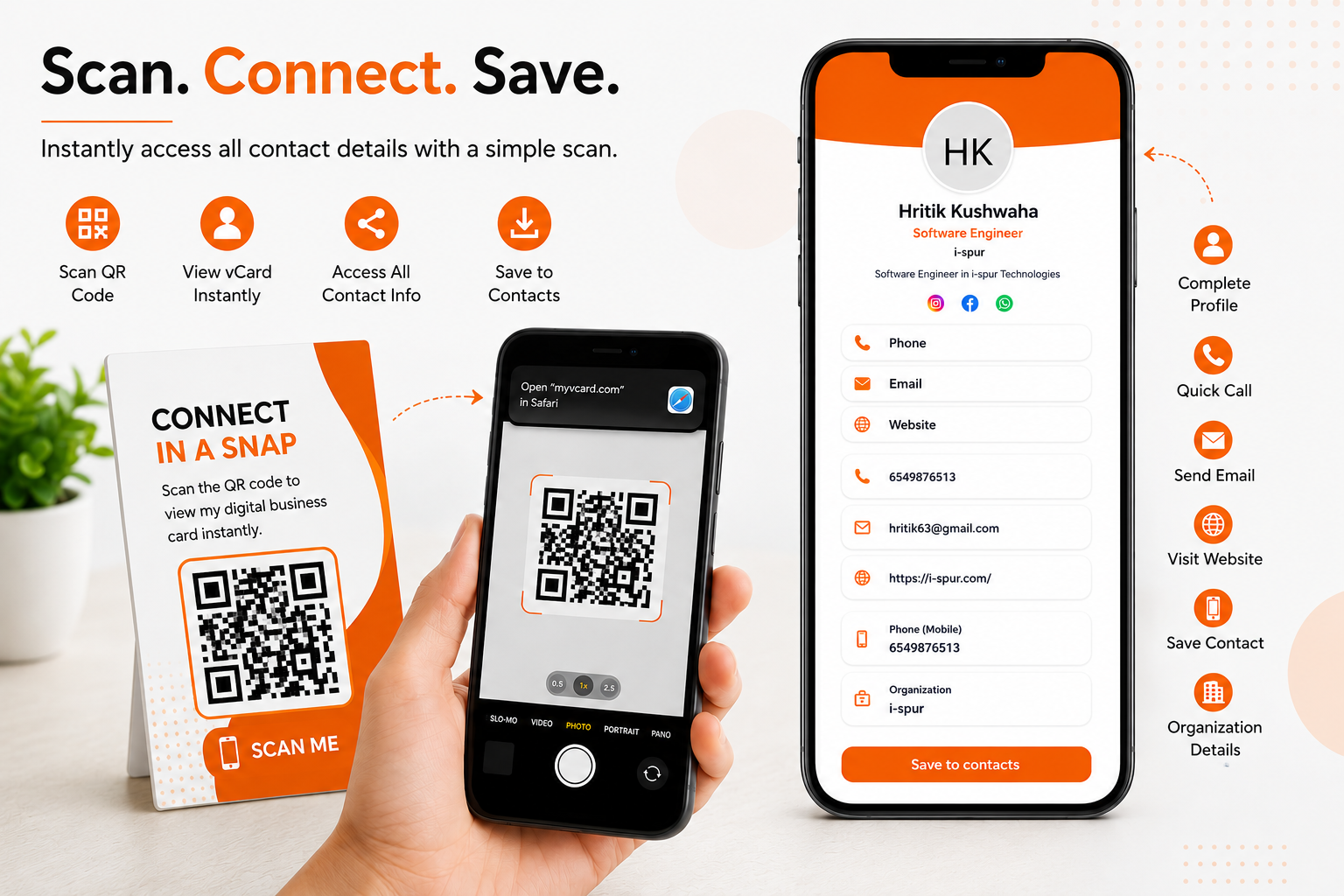
A digital business card provides a modern way to present your professional information in one convenient place. Instead of giving someone a piece of paper containing a name, phone number, email address, and website, you can provide a digital profile that can contain your complete professional identity. A person can access the card through a digital link or scan a QR code using a smartphone and immediately view the information you have chosen to share.
With Spur QR digital vCard solution, professionals and businesses can create a customized digital card containing personal information, company details, contact information, address, professional description, profile image, website, and social media links. The result is a convenient digital profile that can be shared during meetings, networking events, customer interactions, email communication, social media conversations, and many other situations.
More importantly, a digital business card is not simply a replacement for a paper card. It can become a central point for your professional contact information and an easy way to connect the physical world with your digital presence.
What Is a Digital Business Card?
A digital business card is an online version of a traditional business card. Instead of storing your professional information on a printed piece of paper, the information is presented through a digital page that can be accessed using a smartphone, computer, or other internet-connected device.
The concept is simple. You create your professional profile by entering information such as your name, designation, company, phone number, email address, website, business address, profile image, description, and relevant social or professional links. Once your card is created, you can share it with other people using its digital link or QR code.
For example, imagine that you are attending a business meeting and someone asks for your contact details. With a traditional business card, you would hand over a printed card and expect the person to manually save the information later. With a digital vCard, you can simply show your QR code. The other person scans it with their smartphone and opens your digital card.
This small change can make contact sharing considerably faster and more convenient.
The same concept can be used by an individual professional, a freelancer, a salesperson, a company employee, a business owner, a consultant, a real estate agent, a service provider, or an entire organization.
Why Traditional Business Cards Are No Longer Enough
Traditional business cards have been used successfully for decades, and they remain useful in many situations. However, they have an important limitation: they are static.
Once a business card has been printed, the information on it cannot be changed.
Suppose a sales executive receives a promotion and their designation changes. The printed cards showing the previous designation are now outdated. Perhaps the company changes its website, the employee changes their phone number, the office moves to another location, or the business launches new social media channels. In each case, old cards may contain information that is no longer correct.
A company may therefore end up repeatedly printing new cards whenever information changes.
There is another limitation. A traditional business card has very limited space. You may be able to print a phone number, email address, website, designation, and perhaps a few social media details, but you cannot realistically provide every relevant digital connection without making the card crowded.
A digital business card solves this limitation by moving the information into a digital environment.
Instead of trying to fit everything onto a small piece of paper, the digital profile can present your important information in a structured and mobile-friendly format. Your phone number, email address, website, address, social profiles, and professional description can all be presented together.
This makes the digital card much more suitable for the way modern businesses communicate.
What Makes a QR Code Digital Business Card Different?
The QR code is one of the most convenient parts of a digital vCard experience.
A QR code acts as a bridge between something physical and something digital. It can be displayed on a phone screen, printed on a brochure, placed on a business counter, added to a presentation, displayed at an exhibition booth, or included in other business materials.
When someone scans the code using their smartphone, they can be directed to your digital business card.
This means you do not have to repeatedly explain your phone number, email address, website, or social media accounts. Instead, you can provide one simple entry point to your professional information.
Consider a salesperson attending a trade exhibition. Hundreds of people may visit the company's booth throughout the day. Giving every visitor a printed business card is possible, but it requires physical inventory and creates additional work. A QR code displayed at the booth can allow visitors to access the salesperson's or company's digital card immediately.
The same idea works in a completely different environment.
A restaurant could display a QR code at its reception desk. A real estate agent could place one on a property brochure. A consultant could display one during a presentation. A freelancer could place one on a portfolio. A company could add one to an employee's desk or email signature.
The technology remains the same, but the business application changes according to the user's needs.
Your Digital Business Card Becomes Your Professional Identity
One of the biggest advantages of a digital vCard is that it can represent more than your contact details.
A professional introduction normally answers several questions.
Who are you? Where do you work? What do you do? How can someone contact you? Where can someone learn more about you? Which professional or social platforms can they use to connect with you?
A well-designed digital card can bring these answers together.
For example, a professional may have a profile containing their name, job title, company name, professional description, phone number, email address, website, address, LinkedIn profile, Instagram profile, YouTube channel, and WhatsApp contact.
Instead of asking another person to search for each of these details individually, the digital card provides a single location.
This makes the card useful not only for exchanging contact information but also for establishing a stronger professional presence.
How to Create a Digital vCard with Spur QR
Creating a digital business card with Spur QR is designed around a straightforward process.
The first stage is selecting a suitable card template. The template determines the visual appearance of your digital card. Different people and businesses may have different preferences, so having multiple layouts allows users to select a design that fits their professional identity.
A corporate employee may prefer a clean and formal appearance, while a creative professional may want a more visually distinctive layout. A business owner may want the company identity to be more prominent, while a freelancer may want their personal name and services to receive more attention.
The template is therefore not simply decoration. It helps determine how information is visually organized and how visitors experience your digital profile.
After selecting the template, the next stage is entering your information.
The personal information section allows you to provide your name and website. Company information can include the organization you represent and your professional position or title. This immediately communicates your identity and role to anyone viewing the card.
Contact information is another important part of the profile. A digital business card can provide multiple communication methods, allowing the visitor to choose whether they want to call, email, or visit your website.
For businesses that have a physical location, address information can also be included. Street, city, state, postal code, and country details can help customers and business contacts understand where the business or professional is located.
The profile photo section provides another layer of personalization. A professional photograph can make it easier for people to recognize the person they met, particularly after networking events, conferences, meetings, or sales conversations. If a user does not want to upload a photo, an initials-based profile can still provide a clean visual identity.
The personal description section is particularly useful for explaining what you do. Rather than simply stating your job title, you can use this space to briefly describe your expertise, services, or professional focus.
For example, instead of simply writing "Business Consultant," a professional could describe their role as helping organizations improve operations, technology adoption, and digital processes.
The social links section then allows you to connect your digital presence. Depending on your requirements, you can provide platforms such as Instagram, Facebook, LinkedIn, YouTube, X/Twitter, WhatsApp, and other relevant profiles.
The result is a single professional page that brings together the information that would otherwise be distributed across multiple channels.
Digital Business Cards for Business Owners
For business owners, a digital vCard can become a convenient way to introduce both themselves and their company.
When meeting a new customer, supplier, investor, partner, or potential employee, the business owner can share their digital card immediately.
The card can communicate the owner's name and role while also providing the company's website, contact information, social media presence, and other important details.
This can be particularly valuable for small and medium-sized businesses.
A small business owner may not have a dedicated marketing team, sales team, and communications department. Their own professional identity is often closely connected to the business. A digital business card provides a simple way to combine personal and business information into one professional profile.
Instead of giving someone several different links, the owner can provide one digital destination.
Digital vCards for Employees
Digital cards are also highly useful for organizations with multiple employees.
Imagine a company with a sales department containing 20 employees. Traditionally, each employee might have a printed business card containing their name, designation, phone number, email address, and company details.
Now imagine that several employees change roles during the year.
The organization may need to update and reprint cards.
A digital card can make this type of information management more flexible because the employee's professional information exists digitally.
The concept can be extended across departments. Sales employees can have their professional contact information, HR employees can provide recruitment-related contact details, managers can share their corporate profiles, and executives can provide their professional networking information.
This creates a consistent digital identity while still allowing each employee's information to be specific to their role.
Digital Business Cards for Sales Teams
Sales professionals are among the people who can benefit most from digital contact sharing.
A sales representative may meet dozens of prospects during a conference, exhibition, client visit, product demonstration, or business meeting. Every interaction creates a potential opportunity, and the ability to make follow-up communication easy is important.
A digital vCard gives the prospect a convenient way to access the salesperson's contact information.
Instead of searching through a wallet or desk for a paper card later, the prospect already has the digital information available on their device.
The salesperson can also share the same card through WhatsApp, email, or another communication channel after the meeting.
This makes the digital card useful both during the initial introduction and during the follow-up process.
Digital Cards for Freelancers and Independent Professionals
Freelancers often need to represent themselves professionally without the infrastructure of a large organization.
A designer, developer, photographer, writer, marketer, consultant, architect, trainer, or other independent professional may work with many different clients.
Their professional identity may consist of several different digital properties: a portfolio website, LinkedIn profile, Instagram account, WhatsApp number, email address, and phone number.
A digital vCard can bring these channels together.
For example, a photographer can provide their name, profession, phone number, email, website, Instagram, YouTube, and professional description in one place.
A potential customer does not need to search for each platform separately.
The digital card becomes a simple professional introduction that can be shared whenever a new client asks for contact information.
Digital Cards for Consultants and Service Providers
Consultants and service providers depend heavily on trust and professional communication.
A potential client may meet a consultant at a conference or through a business introduction. The consultant's first challenge is to make it easy for that person to remember who they are and how to contact them.
A digital business card can provide the consultant's name, specialization, company, contact details, website, professional description, and professional networking profiles.
The card can therefore serve as a digital reminder of the conversation.
This is particularly useful when someone meets multiple professionals during the same event.
Instead of relying entirely on memory or a physical card, the prospect can open the consultant's digital profile and immediately see their professional information.
Digital Business Cards for Real Estate Professionals
Real estate professionals frequently communicate with customers in different environments.
They may meet potential buyers at properties, exhibitions, offices, residential projects, networking events, or through referrals.
A QR-enabled digital card can be included in brochures, property advertisements, promotional material, office displays, and other marketing assets.
A customer scanning the code can reach the agent's digital profile and find the relevant contact information.
For an industry where fast communication and follow-up are important, this can be a practical addition to traditional marketing methods.
Digital vCards for Local Businesses
The value of a digital business card is not limited to corporate professionals.
Local businesses can also use QR-based digital profiles.
Consider a salon, café, restaurant, retail store, repair service, fitness center, consultancy, travel agency, educational service, or other local business.
Customers often need basic information such as the business name, phone number, website, location, social media profile, or WhatsApp contact.
Instead of putting separate QR codes for every digital channel, a business can use a digital card as a central profile.
This makes the experience easier for customers because they have one place to start.
Digital Business Cards at Conferences and Events
Business networking events are one of the strongest use cases for QR-enabled digital cards.
At a conference, exhibition, seminar, workshop, or trade show, people may meet dozens of new contacts in a single day.
Physical business cards can become difficult to organize.
A digital card changes the experience.
When two professionals meet, one person can simply show their QR code. The other person scans it and opens the digital profile.
The same approach can be used at exhibition booths. Instead of printing separate contact information on every piece of promotional material, a company can place its digital card QR code on banners, brochures, presentation screens, and booth displays.
This allows the physical event experience to connect directly to the company's digital presence.
Use Your Digital Card With Email
Email remains one of the most important communication channels for businesses.
A digital business card can complement email communication by giving recipients an additional way to access your professional information.
For example, a company employee can include their digital card link in their email signature.
This means every professional email can contain an easy way for the recipient to view the sender's contact information and digital profile.
This is especially useful when communicating with someone for the first time.
Instead of requiring the recipient to manually save information from the email signature, the digital card provides a dedicated professional profile.
Use Your Digital Card With WhatsApp
WhatsApp is widely used for personal and business communication.
Business owners, sales representatives, freelancers, consultants, service providers, and customers frequently use messaging applications to communicate.
A digital card can be shared directly through a WhatsApp conversation.
This is particularly useful when someone says, "Please send me your contact details."
Rather than sending a separate message containing your name, phone number, email address, website, LinkedIn profile, and other information, you can share your digital card.
The recipient can open it whenever they need your information.
Use Your Digital Card on Social Media
Social media profiles are another important part of modern professional identity.
A professional may have a LinkedIn profile for business networking, Instagram for visual content, YouTube for educational videos, and other social channels for communication and marketing.
The problem is that these profiles are often separated.
A digital vCard can act as a central connection point.
Instead of asking someone to search for you on different platforms, your digital profile can provide the relevant links in one place.
This is particularly useful for creators, entrepreneurs, freelancers, consultants, influencers, agencies, and businesses that actively use social media.
Use Your Digital Card on Your Website
A website is usually the central digital presence of a business.
Adding a digital business card can create another convenient way for visitors to connect with a specific person or department.
For example, a company could have a "Contact Our Team" section where employees have access to their individual digital cards.
A visitor could select a salesperson, consultant, manager, or other employee and view their professional contact information.
This can make the website more useful as a communication platform rather than simply an information page.
Use QR Codes on Printed Marketing Materials
Digital does not mean you have to completely stop using physical marketing material.
In fact, QR codes make physical marketing material more useful by connecting it to digital information.
A company can print its digital card QR code on brochures, flyers, posters, packaging, business cards, exhibition banners, presentation materials, and office signage.
The printed material attracts attention, while the QR code provides a path to digital information.
This creates a simple connection between offline marketing and online communication.
Digital vCards for Companies With Multiple Departments
Larger organizations can use the same concept across different departments.
For example, a company may have separate digital profiles for its sales team, HR department, customer support team, management, regional offices, and business development team.
Each profile can provide the information most relevant to that role.
A customer looking for a sales representative can access sales contact information. A job applicant can find the relevant HR contact. A business partner can connect with the appropriate business development employee.
This makes digital contact sharing more organized.
Why a Digital Card Can Improve Professional First Impressions
Professional communication starts with the first interaction.
The way you present your contact information can influence how people perceive your organization and your attention to detail.
A clean digital card communicates that you are prepared to provide information in a modern and convenient way.
The design also matters.
A well-structured card should make important information easy to find. The name should be clear. The designation should be understandable. Contact buttons should be easy to identify. Important links should be accessible without unnecessary navigation.
The purpose of the design is therefore not simply visual appeal. It is to create a better communication experience.
The Importance of Keeping Your Digital Profile Professional
Creating a digital card is easy, but creating a useful digital card requires thoughtful information.
Your card should contain accurate information and present it clearly.
Your name should be written consistently. Your designation should represent your current role. Your company information should be correct. Your phone and email should be active. Your website and social links should point to the appropriate profiles.
Your profile description should also explain what you do in a concise and professional manner.
A digital card is often shared with people who may become customers, partners, employers, suppliers, or professional contacts, so it should be treated as an extension of your professional identity.
Digital Business Cards and Modern Customer Experience
Customers increasingly expect businesses to make communication easy.
If a customer has to search for a phone number, find a website, locate a social profile, and then determine how to contact a company, the process can become unnecessarily complicated.
A digital business card simplifies the first step.
The customer receives one digital destination where the important information is presented together.
This does not replace a company's website, CRM, customer support system, or social media channels. Instead, it provides a convenient entry point to them.
The digital card can therefore be viewed as a small but useful part of a broader customer experience strategy.
Digital vCards Can Be Useful Across Almost Every Industry
One of the strongest advantages of this technology is its flexibility.
The same digital card concept can be adapted for corporate employees, entrepreneurs, doctors, lawyers, engineers, designers, developers, consultants, sales representatives, real estate agents, photographers, trainers, educators, financial professionals, marketers, business owners, and many other professionals.
The information displayed may change according to the industry, but the fundamental purpose remains the same: make professional information easy to access and easy to share.
This makes digital vCards useful for both individuals and organizations.
Digital Business Cards Are Useful Beyond Networking
Although networking is one of the most obvious applications, digital cards can be used in many situations where contact information needs to be shared.
An employee can place the QR code on their desk. A company can place it at reception. A salesperson can display it during a presentation. A consultant can include it at the end of a proposal.
A freelancer can add it to their portfolio. A business owner can print it on promotional material. A conference attendee can show it from their phone. A company can include it in an email signature.
The important idea is that the digital card is not restricted to one location.
It can travel with the person and appear wherever their professional identity needs to be shared.
Why QR-Based Digital Cards Are Convenient for Mobile Users
Most people today carry a smartphone throughout the day.
This makes QR codes particularly useful because they do not require specialized hardware for basic scanning. A smartphone camera can generally be used to recognize a QR code and open the associated digital destination.
This creates a very simple interaction:
See the QR code → Scan the QR code → Open the digital card → View the information.
The process eliminates much of the manual typing involved in traditional contact exchange.
For businesses that interact with customers frequently, reducing friction in this way can make communication more convenient.
Digital vCard as a Long-Term Professional Asset
A printed business card is normally designed for a single exchange.
A digital card can remain part of your professional identity for a much longer period.
You can share the same digital profile repeatedly with different people.
You can use it at meetings, events, customer visits, online conversations, presentations, and networking opportunities.
This creates consistency.
Instead of creating a new method of introducing yourself every time you meet someone, your digital card becomes a standard part of your professional communication.
How Businesses Can Build a Digital Card Strategy
Businesses should think beyond simply creating one card.
A larger organization can establish a consistent approach to digital contact sharing.
The company can determine which information employees should include, how company branding should be represented, which contact channels should be prioritized, and where QR codes should be displayed.
For example, a company may want sales employees to prioritize phone, email, WhatsApp, and LinkedIn. HR employees may prioritize recruitment-related communication. Customer-facing teams may highlight support channels.
The important point is that the digital card should be designed around the actual communication needs of the role.
Digital Cards Can Support a More Connected Business Presence
Modern businesses rarely operate through one communication channel.
A customer may discover a business through social media, visit its website, contact it through WhatsApp, speak to an employee by phone, and later communicate through email.
A digital business card can help connect these channels at the individual professional level.
It provides one place where important contact and digital information can be presented together.
This makes the digital card particularly valuable in environments where multiple communication channels are part of everyday business activity.
What Information Should You Put on a Digital Business Card?
The best digital card is not necessarily the one containing the most information.
It is the one containing the right information.
For most professionals, the core information should include the person's name, designation, company, phone number, email address, website, and a short description.
Additional information can be added when it is relevant, such as an office address, WhatsApp number, LinkedIn profile, Instagram profile, Facebook page, YouTube channel, or other professional links.
The goal should always be clarity.
A visitor should be able to understand who you are, what you do, and how to contact you without having to search through unnecessary information.
Frequently Asked Questions About Digital Business Cards
What is a QR code business card?
A QR code business card is a digital business card that can be accessed through a QR code. Instead of manually entering contact information, a person can scan the code and open the digital profile.
What is a vCard?
A vCard is a digital representation of contact information. In modern business usage, the term is commonly associated with digital contact profiles containing information such as names, phone numbers, email addresses, company details, websites, and other professional information.
Can a digital business card be used by a company?
Yes. Companies can use digital cards for business owners, executives, employees, sales representatives, HR teams, consultants, and other customer-facing professionals.
Is a digital business card useful for small businesses?
Yes. Small businesses can use digital cards to provide customers with their contact information, website, social media links, business information, and other relevant details from one convenient location.
Can freelancers use QR business cards?
Yes. Freelancers can use them to connect their professional identity with their portfolio, website, email, phone number, social profiles, and other online resources.
Can I share a digital card through WhatsApp?
A digital card can be shared through messaging platforms such as WhatsApp by sending its digital link or other supported sharing method.
Where can I display my QR code?
A QR code can be displayed on phones, business counters, brochures, presentations, websites, email signatures, banners, flyers, office signage, packaging, and other physical or digital materials.
Is a digital business card better than a printed card?
Both have their advantages. A printed card can be useful for traditional networking, while a digital card offers easier digital sharing, richer information, online links, and greater flexibility. Many businesses can benefit from using both together.
Can digital business cards be used for employees?
Yes. Businesses can provide digital cards to employees so that each employee has a professional digital profile containing their current contact and company information.
The Future of Business Networking Is Digital
Business networking is becoming increasingly connected to digital communication.
People no longer interact with businesses through only one channel. A single professional relationship may involve a face-to-face meeting, a phone call, WhatsApp conversation, email exchange, LinkedIn connection, website visit, and social media interaction.
A digital business card provides a simple way to bring many of these connections together.
The QR code makes the experience even easier because it allows people to move from a physical interaction to a digital profile with a simple scan.
This is why digital vCards are becoming a practical tool for modern professionals and businesses.
Start Creating Your Digital Business Card With Spur QR
Your contact information is part of your professional identity. The way you share it should therefore be simple, professional, and convenient.
With the Spur QR digital vCard solution, you can create a professional digital card by selecting a suitable template and entering your personal, company, contact, address, description, profile, and social information.
You can create a card that represents your professional identity and use it across different business situations.
Whether you are a business owner meeting a potential customer, a salesperson attending an exhibition, a freelancer meeting a new client, a consultant presenting your services, an employee representing your company, or a professional building your network, a digital business card gives you a convenient way to share your information.
Instead of asking people to remember your details, search for your website, or manually type your phone number and email address, you can provide one simple digital destination.
Create your digital vCard, share it through your QR code, and make every professional introduction easier.
Final Thoughts
The traditional business card solved an important problem: it gave people a convenient way to exchange contact information.
The digital business card takes that idea further.
It provides a flexible digital profile that can contain more information, connect to online platforms, support QR-based sharing, and fit naturally into the way modern businesses communicate.
For an individual, it can become a professional digital identity.
For a freelancer, it can become a gateway to their portfolio and social profiles.
For a salesperson, it can become a convenient networking tool.
For a local business, it can become a central contact point.
For a company, it can become part of a standardized digital identity for employees and teams.
The real value is not simply in replacing paper. The value is in making professional information easier to access, easier to share, and easier to connect with.
A simple introduction can now become a digital connection.
A business meeting can lead directly to a professional profile.
A printed brochure can lead to an online contact page.
A presentation can lead to a direct connection.
A QR code can turn a physical interaction into a digital relationship.
That is the real purpose of a modern digital business card.
With Spur QR, your professional information can be ready to share whenever and wherever you need it.
Create. Share. Connect.
Create your professional digital vCard with Spur QR and make your next connection just one scan away.