Table of Contents
- Digital Business Cards: The Smarter Way to Share Your Professional Identity
- What Is a Digital Business Card?
- Why Traditional Business Cards Are Becoming Less Convenient
- How a vCard QR Code Changes Networking
- Your Contact Information in One Place
- A Better Experience for Sales Professionals
- Digital Business Cards for Freelancers and Consultants
- Digital Business Cards at Conferences and Events
- Your Professional Details Can Be More Complete
- Personal Branding Becomes Easier
- What Happens When Your Information Changes?
- Use Your Digital Business Card Beyond Meetings
- A Digital Business Card Can Save Time
- Why the QR Code Is More Than a Visual Element
- How to Create a Professional vCard QR Code
- Where Can You Use a vCard QR Code?
- Digital Does Not Mean You Have to Give Up Printed Cards
- The Future of Professional Networking Is About Easier Connections
- Final Thoughts
Digital Business Cards: The Smarter Way to Share Your Professional Identity
A business card has always been a simple way to introduce yourself, share your contact details, and make it easier for someone to remember you after a meeting. But the way people communicate and build professional relationships has changed. Today, a single contact can involve a phone number, email address, website, social media profiles, company information, job title, location, and sometimes even a profile photo. Trying to fit all of that information onto a small printed card can quickly become difficult.
This is where a digital business card and vCard QR Code offer a more practical approach. Instead of giving someone a card that they may put in a wallet, lose, or forget to enter into their phone, you can give them one QR code that opens your complete digital contact profile and allows them to save your details directly. Spur QR's vCard QR Code solution is designed around this idea, allowing users to create a digital contact profile containing information such as name, company, position, mobile number, email, website, address, social links, and profile photo, and share it through a QR code.
What Is a Digital Business Card?
A digital business card is an online version of a traditional business card that allows your professional information to be shared electronically. Rather than depending only on a printed piece of paper, your contact details are presented through a digital profile that people can access from their smartphones. A vCard QR Code acts as the bridge between the physical and digital experience. Someone can scan the QR code and access your contact information without manually typing every detail.
This is especially useful because professional information today is rarely limited to just a name and phone number. A modern professional may want to share their company, job position, email, website, physical address, LinkedIn profile, Instagram account, WhatsApp contact, YouTube channel, and other social profiles. Spur QR's vCard generator provides fields for these types of information and allows users to create a complete digital contact profile rather than simply displaying a single phone number.
The real value of a digital business card is therefore not simply that it removes paper. Its bigger advantage is that it makes your professional identity easier to access, remember, and save. Imagine meeting someone at a conference and exchanging contact information. With a traditional business card, the other person may need to manually type your name, company, phone number, and email address into their phone later.
They may make a typing mistake or forget to save the information altogether. With a vCard QR Code, the interaction can be much more direct: scan the code, view the digital profile, and save the contact. Spur QR specifically highlights the ability to save contact information to a phone without manually typing the details.
Why Traditional Business Cards Are Becoming Less Convenient
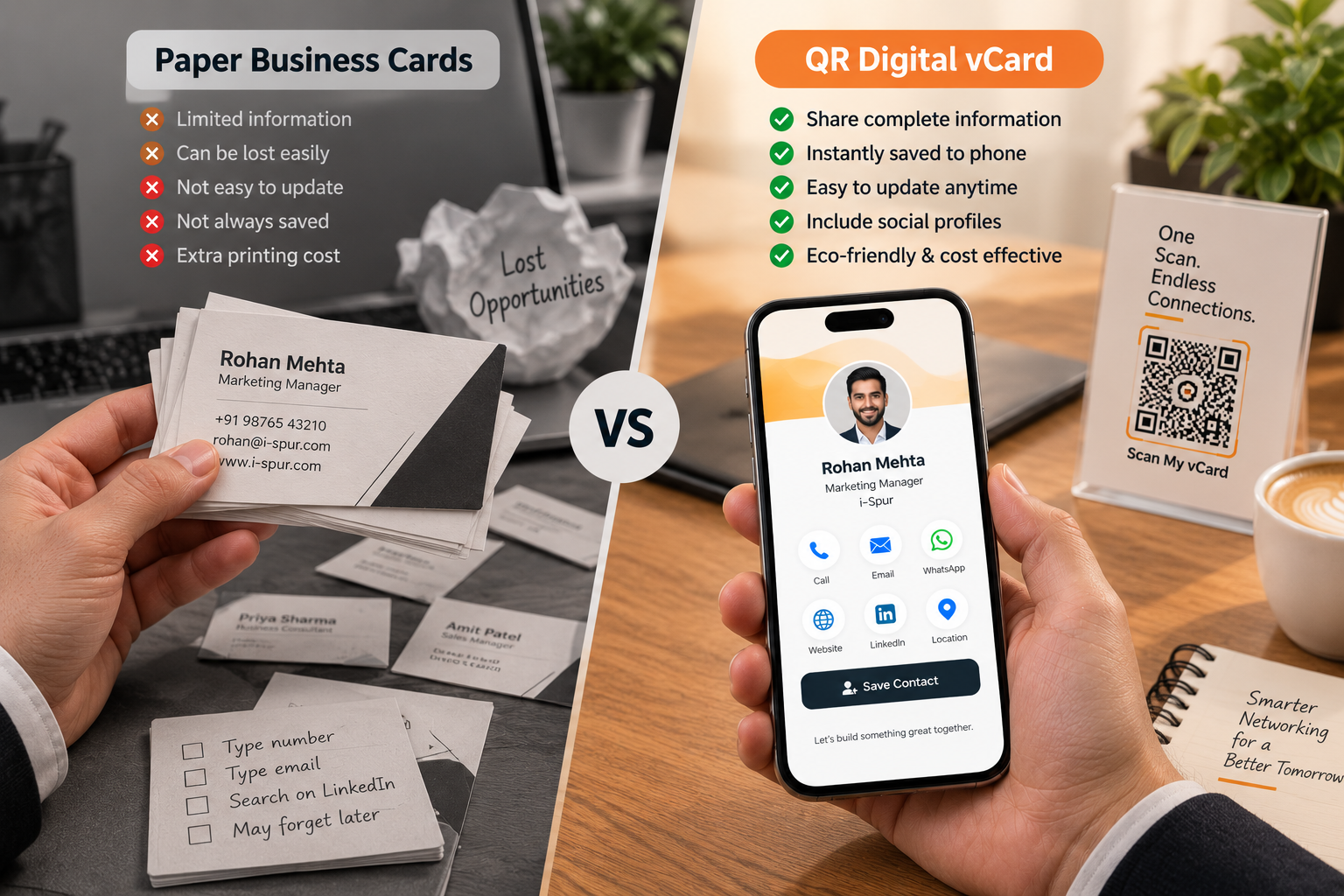
Printed business cards are still useful, but they have limitations that become more noticeable as professional communication becomes more digital. A printed card can contain only a limited amount of information, and once it has been printed, the information on it cannot easily be changed. If you change your phone number, update your website, move to a different company, receive a new job title, or change your social media profile, the old cards still contain the previous information. That means you may eventually have to print another batch of cards. A digital business card approaches the problem differently because your contact profile can contain much more information and can be accessed digitally.
Another issue is what happens after someone receives a physical business card. The person may put it into a wallet, place it on a desk, or take a photo of it, but none of these actions guarantee that the information will actually become part of their digital contacts. A digital business card is built for the environment where people already manage their professional relationships: their smartphones. Instead of asking someone to remember to enter the details later, the QR-based experience makes the digital contact available immediately.
This does not mean printed business cards have no value. In fact, combining a physical business card with a vCard QR Code can create a stronger experience. The physical card provides something tangible while the QR code provides access to the complete digital profile. The two formats can work together rather than competing with each other.
How a vCard QR Code Changes Networking
Networking is often about the quality and continuity of the connection rather than simply exchanging information. You may meet dozens of people during a conference, trade show, business meeting, workshop, or professional event. Remembering every name and contact detail afterward can be difficult. A digital business card gives people a convenient way to access your information at the moment they meet you.
For example, imagine a sales professional attending a business exhibition. Instead of handing every visitor a traditional card and hoping they enter the details later, the professional can display a vCard QR Code on a badge, presentation screen, business card, booth display, or phone. A visitor can scan it and access the professional's contact profile. The interaction becomes quicker, and the visitor has a digital version of the contact information immediately available.
This can be particularly valuable when networking involves multiple platforms. Someone may want to call you, send you an email, visit your website, connect with you on LinkedIn, or communicate through WhatsApp. A digital profile can bring these options together rather than forcing the other person to search for each profile separately. Spur QR's vCard page supports social links including Instagram, Facebook, LinkedIn, YouTube, Twitter/X, WhatsApp, and Snapchat.
Your Contact Information in One Place
One of the strongest reasons to use a digital business card is organization. Instead of giving people separate places to find different parts of your professional identity, a digital vCard can bring those details together.
A professional profile can include:
- Name, company, job title, mobile number, email, website, address, and other contact information.
- Social profiles such as LinkedIn, Instagram, Facebook, YouTube, WhatsApp, and other supported platforms.
Spur QR's vCard generator provides dedicated fields for personal information, company information, contact details, address, personal description, profile photo, and social links.
This makes the digital business card more than an online replacement for a printed card. It can become a compact professional identity page. Someone viewing your profile can understand who you are, what company you represent, what your role is, and how they can contact you.
A Better Experience for Sales Professionals
Sales professionals depend heavily on relationships and follow-ups. A missed phone number, incorrectly saved email address, or forgotten company name can make follow-up more difficult. A digital business card can help reduce these small points of friction during the first interaction.
Consider a salesperson meeting a potential client at an exhibition. The conversation may last only a few minutes, but the salesperson wants the prospect to remember the company and know how to get in touch later. A QR code can provide a direct path to that information. Instead of relying on the prospect to manually enter everything, the prospect can scan and save the contact.
The same approach can be useful during client meetings, product demonstrations, business visits, networking events, and sales presentations. The QR code can become part of the professional's regular introduction.
The important point is that the digital business card should support the conversation rather than interrupt it. You do not need to explain a complicated process. A simple message such as “Scan to Save My Contact” can be enough.
Digital Business Cards for Freelancers and Consultants
Freelancers, consultants, independent professionals, creators, and entrepreneurs often have a professional identity that extends beyond one company. Their business card may need to communicate their name, services, website, portfolio, social profiles, and contact information.
A digital business card can make this information easier to present. Instead of trying to describe every service verbally or fit everything onto a printed card, the professional can use the digital profile as a central point of contact.
For a freelancer, this can be particularly useful when meeting a potential client. The QR code can provide the person's contact details while also making their website and professional social profiles accessible. The result is a more complete introduction without requiring the person to search for additional information.
Digital Business Cards at Conferences and Events
Conferences and networking events create an environment where people exchange contact information rapidly. You might meet someone during a coffee break, speak with a potential partner after a presentation, or connect with a prospect while walking through an exhibition hall. In these situations, speed matters.
A traditional card exchange requires two people to physically exchange cards and later remember what they discussed. A digital business card can make the contact exchange part of the conversation itself.
The vCard QR Code can be printed on an event badge, displayed on a booth, included on promotional material, or shown directly from a smartphone. Spur QR specifically lists networking events and conferences among the use cases for its digital business card solution.
This also helps professionals maintain consistency. Instead of carrying several different versions of a card, the same digital profile can be used across multiple networking situations.
Your Professional Details Can Be More Complete
A printed business card forces you to decide what information deserves limited space. A digital profile gives you considerably more room to present useful information.
For example, someone viewing a digital business card may want to know not only your phone number but also your company, position, website, location, social profiles, and other professional information. Spur QR's vCard tool is built to collect these details into one digital profile.
This can make the first impression more informative. Someone who scans your card does not simply receive a number; they can understand the professional identity behind the contact.
That is especially useful when your work depends on credibility and visibility. A consultant may want people to see their website and LinkedIn profile. A business owner may want customers to find the company website and WhatsApp contact. A creative professional may want visitors to discover their social profiles. A sales representative may want prospects to have immediate access to the correct company and contact information.
Personal Branding Becomes Easier
A business card is also a branding tool. The design, typography, colors, logo, and information hierarchy can influence how people remember a professional or company. Digital business cards provide another opportunity to maintain that identity.
Spur QR's vCard creator allows users to choose templates and customize elements such as font and accent color. The QR code itself can also be customized with patterns, corner styles, foreground colors, background colors, gradients, and logos.
This gives professionals the ability to create something that feels connected to their brand rather than using a generic contact page. A well-designed digital profile can feel like an extension of a company's website and visual identity.
However, branding should always support usability. The most important thing is that people can easily understand the information and access the contact details. Design should make the experience clearer, not more complicated.
What Happens When Your Information Changes?
One of the biggest weaknesses of printed business cards is that they are fixed. Once they are printed and distributed, you cannot easily update the information on those cards. If your phone number changes or your professional role changes, people holding the old card still have the old details.
A digital business card can provide more flexibility. Spur QR states that its digital business card can be updated without requiring the physical QR image to be reprinted.
This can be particularly useful for professionals whose details change over time. If the digital profile is updated, the QR code can continue serving as the access point to the current information. This means a QR code printed on a long-term business asset can potentially remain useful while the digital information evolves.
For businesses, this can also reduce the need to repeatedly redesign and distribute printed materials whenever a small contact detail changes.
Use Your Digital Business Card Beyond Meetings
A digital business card does not have to be limited to face-to-face networking. It can be integrated into different parts of your professional communication.
For example, a vCard QR Code can be placed on a traditional business card, email signature, presentation, proposal, brochure, booth display, or other professional material. Spur QR specifically identifies business cards, networking events, email signatures, sales professionals, and freelancers as use cases for its digital business card solution.
This creates a consistent way for people to access your contact information regardless of where they discover you.
Imagine receiving an email from someone you have never met. Their email signature contains a small QR code with a message such as “Save My Contact.” You can scan it and access their professional information. Later, when you meet the person in real life, the same QR code can appear on their business card. The experience remains consistent across different communication channels.
A Digital Business Card Can Save Time
Time is often lost through small administrative tasks. Typing names, entering phone numbers, copying email addresses, searching for websites, and finding social profiles may each take only a few seconds, but repeated hundreds of times, these actions become unnecessary friction.
A vCard QR Code can simplify the process by bringing the information together in one place. The person receiving the contact does not have to manually enter every field. Spur QR specifically describes its vCard solution as allowing recipients to save details without typing them manually.
This makes the technology useful not because it is complicated, but because it removes unnecessary steps.
Why the QR Code Is More Than a Visual Element
It is easy to think of the QR code as simply a square pattern placed on a business card. But in a digital business card strategy, it serves a much more important role. It becomes the connection between your physical professional presence and your digital identity.
Your printed card, event badge, presentation, office display, or promotional material exists in the physical world. Your contact profile exists digitally. The QR code connects the two.
This is one reason QR technology continues to be useful for businesses and professionals. It does not require people to remember a long web address or search for a person's name on a platform. The physical code provides a direct path to the digital destination.
How to Create a Professional vCard QR Code
Creating a digital business card with Spur QR is designed as a straightforward process. The platform first asks users to choose a card template and then enter their personal, company, contact, address, description, profile photo, and social information. After the profile information is entered, users can customize the design and generate the QR code.
The basic process is:
1. Choose a digital card template and enter your name, company, position, phone, email, website, address, and other relevant details.
2. Add social links and customize the design, then generate your vCard QR Code and use it on printed materials or share it digitally.
The platform also provides downloadable QR formats including PNG, while additional formats such as SVG and PDF are available according to its plan structure.
Where Can You Use a vCard QR Code?
The best use of a digital business card is not restricted to one profession. Almost anyone who regularly exchanges professional contact information can benefit from having a convenient digital identity.
A business owner can display it at a reception desk. A salesperson can place it on a printed business card. A freelancer can include it in proposals. A consultant can add it to presentations. A real estate professional can include it in marketing material. A professional attending an exhibition can display it at a booth. A recruiter can use it while networking. An employee can add it to an email signature.
The more frequently you exchange contact information, the more useful a digital business card can become.
Digital Does Not Mean You Have to Give Up Printed Cards
One common misunderstanding is that adopting a digital business card means completely abandoning traditional business cards. That is not necessary.
In fact, combining both can create a stronger experience. A printed card can provide the immediate physical introduction, while a QR code provides access to the complete digital profile. The person can keep the printed card if they want, but they also have the information stored digitally.
This hybrid approach can be particularly effective for businesses that already use printed materials but want to make them more interactive.
The QR code can be positioned with a simple call to action such as “Scan to Save Contact,” “Scan for My Digital Card,” or “Save My Details.” The instruction tells the recipient exactly what will happen after scanning.
The Future of Professional Networking Is About Easier Connections
Professional networking is not simply about collecting more business cards. It is about making meaningful connections easier to continue. If someone meets you today but cannot find your contact information tomorrow, the opportunity can easily disappear.
A digital business card helps solve this practical problem by putting your professional details into a format designed for modern communication. It can contain more information than a traditional printed card, connect people to your website and social profiles, and make it easier to save contact information.
The vCard QR Code is particularly useful because it does not require a complicated explanation. A QR code can be displayed almost anywhere, and a smartphone provides the natural device for accessing it.
Final Thoughts
The traditional business card introduced people to your professional identity through a small piece of printed paper. A digital business card takes the same basic idea and adapts it to the way people communicate today. Instead of limiting your information to a name, phone number, and email address, a digital vCard can bring together your company, position, website, address, social profiles, profile photo, and other contact information in one accessible profile. Spur QR vCard solution provides these fields, customizable templates, social links, QR design options, and the ability to use the resulting code on business cards or share it digitally.
The biggest benefit is not simply saving paper. It is reducing the distance between meeting someone and becoming a saved contact. A scan can provide the information immediately, while the digital profile gives the recipient a more complete picture of who you are and how they can reach you.
For sales professionals, entrepreneurs, freelancers, consultants, business owners, employees, and anyone who regularly builds professional relationships, a vCard QR Code can become a simple part of everyday networking. Put it on your business card, add it to your email signature, display it at an event, include it in a presentation, or share it directly from your phone. Instead of asking people to remember your details, give them a simple way to save them.
Your business card should not just tell people who you are. It should make it easy for them to stay connected with you.