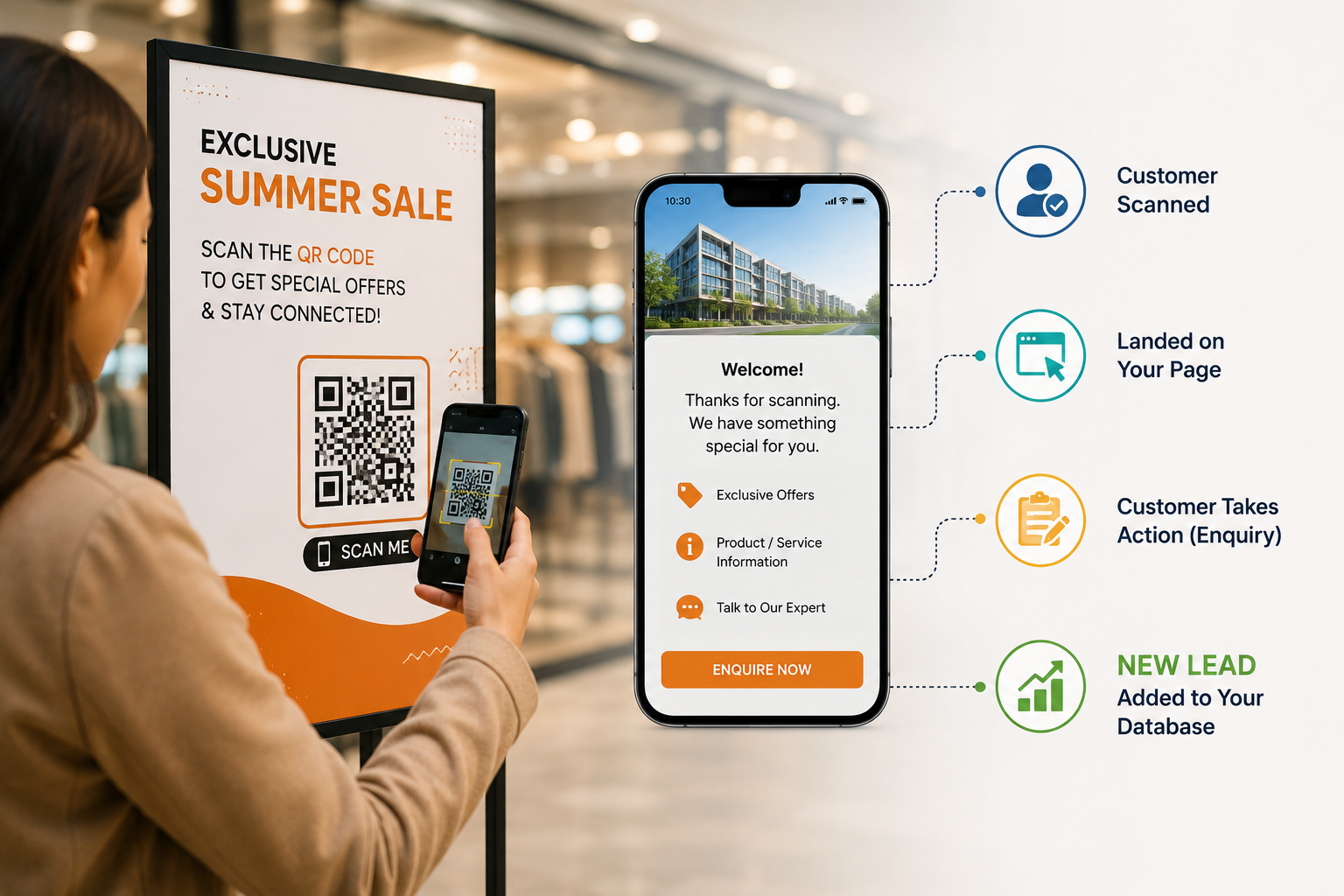
How QR Codes Can Turn Offline Customers Into Digital Leads
For many businesses, the customer journey still begins in the physical world. A person may notice a shop while walking down a street, see an advertisement on a billboard, receive a printed brochure, visit a restaurant, pick up a product from a shelf, attend an event, or walk into a showroom. The business may successfully capture that person’s attention, but there is often a major gap between getting noticed offline and continuing the relationship online. A customer can see an advertisement and walk away, read a brochure and forget about it, or visit a store without leaving behind any useful information for future communication. This is where QR codes can become much more than a convenient way to open a website. When used strategically, a QR code can act as a bridge between a physical customer interaction and a digital lead-generation journey, allowing businesses to turn offline attention into measurable online engagement. Spur QR provides dynamic and customizable QR code options that businesses can use for URLs, contact information, WhatsApp, social platforms, events, product information, feedback, business information, and other digital experiences.
The Gap Between Offline Attention and Digital Leads
One of the biggest challenges with traditional offline marketing is that it can be difficult to know what happens after someone sees your message. Imagine a company putting up a large advertisement outside a busy location. Hundreds or thousands of people may see it during the campaign, but how many were genuinely interested? How many wanted to learn more? How many visited the website later? How many eventually became customers? Without a digital connection, answering these questions can be difficult. The same problem can happen with brochures, business cards, posters, packaging, flyers, banners, menus, product displays, and event materials. These channels can generate awareness, but the interaction often ends when the customer leaves the physical environment.
A QR code changes that journey by giving the customer an immediate next step. Instead of asking someone to remember a website address, search for a business later, type a long URL, or manually save contact information, a business can place a QR code directly where the customer is already looking. With a simple smartphone scan, the customer can be taken to a landing page, enquiry form, WhatsApp conversation, product page, booking page, social media profile, event registration page, offer page, or another digital destination. The important point is not simply that the QR code opens a link. The real value comes from designing what happens after the scan so that casual interest can develop into meaningful digital engagement.
A QR Code Can Become the First Step in a Lead Journey
A lead is not created simply because someone scans a QR code. A scan represents interest, while a lead is created when that interest moves into an identifiable or actionable interaction. This distinction is important for businesses that want to use QR codes for marketing rather than simply providing information.
For example, consider a person walking past a real estate property. A traditional property board may display the project name and a phone number. The person may be interested but may not call immediately. If there is a QR code with a clear message such as “View Floor Plans & Request Details,” the customer can scan it immediately. The QR destination could provide project information, images, floor plans, pricing information, location details, and an enquiry option. The customer has now moved from simply seeing the property to interacting with the business digitally.
The same concept can work in retail. A customer sees a product on a shelf and scans a QR code to discover detailed information, available variants, a product catalogue, an offer, or a way to contact the brand. In a showroom, the QR code can take visitors to a digital catalogue or enquiry form. At an event, it can lead to registration or networking information. On printed advertising, it can connect the customer directly to a campaign landing page. The physical marketing material becomes the starting point, while the digital destination continues the conversation.
Why Offline Customers Are Valuable Digital Opportunities
Offline customers are often already showing some level of intent because they have physically encountered the business, product, service, or advertisement. Someone standing inside a store, looking at a product display, attending a business event, visiting a property site, or reading a promotional poster is already participating in a real-world interaction. The challenge is giving that person a convenient way to continue the interaction.
A QR code reduces friction. Instead of expecting customers to remember information and take action later, the business can invite them to act while their interest is still fresh. This matters because customer attention is often temporary. A person may think, “I will check this later,” but later may never happen. A well-placed QR code creates an opportunity to capture that moment of interest.
The best QR campaigns therefore focus on a simple question: What should the customer do immediately after scanning? The answer could be different depending on the business. A restaurant may want customers to view a menu or receive an offer. A service company may want enquiries. A retailer may want customers to explore a product. A real estate company may want property enquiries. An event organizer may want registrations. A professional may want visitors to save contact details or explore a portfolio.
From QR Scan to Lead: Understanding the Journey
The customer journey can be understood as a series of simple stages. First, the customer encounters the physical marketing material. Second, the customer notices the QR code and understands why scanning it would be useful. Third, the customer scans the code. Fourth, the customer reaches a relevant digital destination. Finally, the customer takes an action that creates value for the business.
This journey sounds simple, but each stage matters. If the QR code is difficult to notice, people may ignore it. If the message around it is unclear, customers may not understand why they should scan. If the landing page is slow or irrelevant, the customer may leave. If there is no clear next action, the scan may never become a lead.
That is why businesses should think of a QR code as part of a complete marketing experience, rather than treating it as a standalone graphic printed on a poster.
Give Customers a Reason to Scan
One of the biggest mistakes businesses make is displaying a QR code without explaining its value. A QR code by itself does not tell the customer what they will receive after scanning. People are more likely to interact when the benefit is clear.
Instead of simply writing “Scan Me,” a business can provide a more specific reason, such as:
- Scan to Get a Free Quote
- Scan to View the Complete Catalogue
- Scan to Claim Your Offer
- Scan to Book an Appointment
- Scan to Request Product Details
- Scan to Join Our Event
- Scan to Chat With Us on WhatsApp
The exact wording should match the destination. If the QR code promises an offer but opens a generic homepage, the customer experience becomes confusing. A strong QR campaign creates a clear connection between the message, the scan, and the action that follows.
QR Codes Can Make Printed Advertising More Measurable
Traditional printed marketing does not have to remain completely disconnected from digital analytics. QR codes can provide a measurable interaction point within brochures, flyers, posters, packaging, signage, direct mail, business cards, and other physical materials.
Suppose a company runs three separate offline campaigns: one through printed brochures, another through a store display, and another through an event. Instead of sending all customers to the same generic website, the company can use different QR destinations or campaigns for each channel. The business can then understand which physical touchpoint is generating stronger digital engagement.
Dynamic QR technology can be especially useful when campaigns need flexibility. Spur QR's platform supports dynamic QR codes where the underlying destination can be updated without replacing the printed QR image, and its site highlights scan analytics as one of the benefits of dynamic QR codes. This means a business can have a QR code printed on a physical asset while keeping the digital destination more adaptable.
Dynamic QR Codes Make Offline Campaigns More Flexible
Imagine printing 10,000 brochures for a marketing campaign. After printing, the business discovers that the original landing page needs to change. With a traditional static QR code pointing directly to that original destination, changing the destination may require replacing the QR code on future materials. A dynamic QR approach can make the campaign more flexible because the destination can be updated while the printed QR code remains the same.
This flexibility becomes particularly useful for businesses running seasonal offers, rotating campaigns, changing product information, events, promotions, or multiple marketing activities. A QR code printed today can continue to serve a purpose even when the content behind it changes.
For businesses, this means offline marketing assets can have a longer useful life. A printed poster does not necessarily need to become irrelevant simply because the original digital campaign has ended. If the QR destination can be managed dynamically, the business can redirect customers to a new relevant experience.
Turning Scans Into Real Leads Requires a Strong Landing Page
Getting someone to scan is only half the job. The digital experience after the scan needs to be designed around the customer’s intention.
A common mistake is sending every QR scan directly to the homepage. A homepage may contain useful information, but it often gives visitors too many choices. If the purpose of the campaign is lead generation, a focused landing page can be more effective. The page should quickly explain what the customer can get and make the next action easy.
For example, a construction company promoting a new project could create a QR destination containing project highlights, floor plans, images, location information, and an enquiry form. A software company could use a QR code on an event banner to take visitors directly to a demo request page. A restaurant could connect a table QR code to a digital menu and promotional offer. A service provider could connect printed advertising to an appointment request page.
The QR code should therefore lead to the next logical step, not simply the most general page available.
QR Codes Can Connect Different Offline Touchpoints
A major advantage of QR marketing is that the same business can use QR codes across many physical touchpoints while creating different digital experiences. A customer may first encounter a QR code on packaging, another on a brochure, another at a showroom, and another on a business card.
Each physical touchpoint represents a different customer context. Packaging can provide product support or additional information. A brochure can provide a detailed catalogue. A showroom QR can provide product specifications or enquiry options. A business card can provide contact details and social profiles. An event QR can provide registration or follow-up information.
Spur QR supports a wide range of QR formats, including URL, WhatsApp, Email, Phone, Event, Product Info, Support, Business Hours, Instructions, Social, Inventory, Warranty, Store Info, Price List, Return Policy, and other business-oriented QR types. This makes it possible to build QR experiences around different customer needs instead of forcing every interaction into the same format.
QR Codes Can Support Lead Generation Across Industries
The potential of QR lead generation is not limited to one industry. A retail business can use QR codes to move shoppers from physical shelves to digital product pages. A real estate company can connect property signage with digital enquiries. A healthcare provider can make appointment information easier to access. An educational institution can connect printed promotional materials with course information or registration. Hotels can use QR codes to connect guests with services, offers, or feedback. Event organizers can use them to connect physical event materials with registration and digital engagement.
For professional service businesses, QR codes can also be placed on business cards, presentation materials, brochures, signage, and networking collateral. Instead of filling a business card with multiple phone numbers, email addresses, social media handles, and website details, the QR code can act as a digital doorway to a complete business profile.
The principle remains the same across industries: the physical interaction creates attention, the QR code creates the digital connection, and the digital experience creates the opportunity for conversion.
Make the QR Experience Mobile-Friendly
Because QR codes are normally scanned using smartphones, the destination should be designed for mobile users. This sounds obvious, but it is easy to overlook. If a customer scans a QR code and lands on a page with tiny text, difficult navigation, slow loading, or a form containing too many fields, the opportunity can disappear quickly.
A good QR landing experience should be easy to understand and easy to act on. The customer should not have to search through several pages to find what was promised by the physical advertisement. If the campaign says “Get a Quote,” the quote request should be easy to find. If it says “View Catalogue,” the catalogue should be immediately accessible.
The fewer unnecessary steps between the scan and the desired action, the better the overall customer experience.
QR Codes Can Help Businesses Understand Which Offline Campaigns Work
One of the most valuable benefits of connecting offline marketing to digital interactions is the ability to learn from customer behavior. Instead of treating every brochure, poster, banner, or display as simply “distributed,” businesses can begin looking at how different physical campaigns perform digitally.
A campaign that receives many scans may indicate strong customer interest. A campaign that receives very few scans may need a different placement, message, offer, design, or audience. Over time, these insights can help businesses make better decisions about where to invest their offline marketing budget.
Spur QR's current platform highlights QR scan analytics and performance tracking, including information intended to help businesses understand scan activity and engagement. This can help turn QR codes from simple access tools into measurable components of a broader marketing strategy.
The Difference Between a QR Code and a QR Lead Strategy
It is important to understand that simply adding QR codes everywhere does not automatically create more leads. The strategy behind the QR code matters more than the code itself.
A strong QR lead strategy answers several questions before the code is printed: Who is going to scan it? Where will they encounter it? What problem or need does the QR experience address? What will they receive after scanning? What action should they take? How will the business measure the result?
When these questions are answered clearly, the QR code becomes part of the marketing funnel. Without this planning, it can easily become another decorative element that customers ignore.
Common Mistakes Businesses Should Avoid
Businesses can improve QR campaign performance by avoiding a few simple mistakes. The first is placing a QR code where customers cannot comfortably scan it. A code printed too small, positioned too high, hidden among other visual elements, or placed in an inconvenient location may receive little engagement. The second mistake is failing to explain the benefit of scanning. Customers need a reason to take action.
Another problem is sending users to irrelevant content. If someone scans a product advertisement and lands on a generic homepage, they may leave because the experience does not match their expectation. Businesses should also test every QR code before publishing or printing it and regularly check that the destination continues to work correctly.
A QR code should also be treated as part of the brand experience. Its design should be clear and scannable while fitting naturally into the surrounding marketing material. Spur QR provides customization options such as patterns, colors, corner styles, backgrounds, and logo uploads, allowing businesses to create QR codes that can better fit their visual identity while maintaining their intended function.
How Businesses Can Build a Simple QR Lead Funnel
A practical approach is to start with one specific campaign instead of putting QR codes on every physical asset at once. Select a clear audience and a clear goal. For example, a retailer might want product enquiries, a service company might want appointment requests, or a real estate company might want property leads.
Then create a QR code that takes customers directly to the relevant digital experience. Add a short call-to-action next to the QR code explaining the benefit. Place it where customers naturally have enough time and motivation to scan. After the campaign begins, monitor the interaction and identify where improvements can be made.
The process can be summarized simply:
- Offline attention → QR scan → Relevant digital experience → Customer action → Lead
- Measure → Learn → Improve → Repeat
The important part is that every stage has a purpose. The QR code is not the final destination; it is the connection between the physical and digital sides of the customer journey.
Why QR Codes Are Becoming Important for Modern Lead Generation
Customer journeys are no longer completely online or completely offline. People discover businesses in physical locations, see advertisements while travelling, interact with products in stores, attend events, visit offices, receive printed materials, and then use their smartphones to research, compare, communicate, and make decisions. Businesses that treat these experiences as separate channels can miss opportunities to connect with customers.
QR codes provide a simple way to connect these two worlds. They can turn a printed advertisement into a website visit, a product display into a product enquiry, a business card into a digital profile, an event poster into a registration opportunity, or a physical store interaction into an online customer relationship.
The real opportunity is not simply getting more scans. It is creating a journey where the scan has a clear purpose and the customer receives something useful immediately.
Final Thoughts
Offline marketing still has enormous value because physical experiences can capture attention in ways that digital advertising sometimes cannot. The challenge is that traditional offline marketing can make it difficult to continue the customer relationship once the person walks away. QR codes provide a practical bridge between these two environments. By connecting physical advertisements, packaging, brochures, signage, business cards, stores, events, and other offline touchpoints to relevant digital experiences, businesses can create a smoother path from attention to engagement and from engagement to lead.
The most successful QR campaigns are not built around the question, “Where can we put a QR code?” They begin with a much more important question: “What do we want the customer to do next?” Once that answer is clear, the QR code becomes a simple but powerful connection between the physical world and the digital journey.
With dynamic QR capabilities, customizable designs, multiple QR use cases, and analytics-focused functionality, platforms such as Spur QR can help businesses make their offline marketing more interactive, measurable, and adaptable.
In a world where customers move constantly between physical and digital experiences, businesses do not always need to choose between offline marketing and digital marketing. The better approach can be to connect them. A well-planned QR code can be the small bridge that turns a moment of offline attention into a valuable digital relationship.