Table of Contents
- QR Code Marketing Is More Than Putting a Code on a Poster
- Every Scan Represents a Moment of Customer Intent
- The Customer Journey Starts Before the QR Code
- Context Can Change the Meaning of a QR Scan
- From Scan Data to Customer Journey Data
- Why Different QR Codes Can Tell Different Stories
- QR Marketing Can Connect Multiple Stages of the Customer Lifecycle
- The Destination Matters as Much as the QR Code
- A Good QR Journey Should Feel Natural
- Dynamic QR Codes Can Make Campaign Management More Flexible
- QR Codes Can Help Compare Physical Marketing Channels
- The Message Around the QR Code Can Influence Behaviour
- QR Marketing Should Be Designed Around One Clear Objective
- Measurement Should Lead to Action
- Common QR Marketing Mistakes Can Break the Customer Journey
- QR Codes Can Become Part of a Larger Marketing Ecosystem
- The Future of QR Marketing Is About Better Experiences, Not More Codes
- Building a More Measurable QR Strategy
- Why Measurable Customer Journeys Matter
- Final Thoughts
QR codes have become a familiar part of everyday life. People see them on product packaging, restaurant tables, posters, business cards, event banners, advertisements, retail displays, receipts, brochures, and even public spaces. Because scanning a QR code has become such a normal smartphone action, it is easy to think of QR codes as nothing more than a quick way to open a webpage. But for modern businesses, that view is too limited.
A QR code can be the starting point of a much larger marketing experience in which a physical interaction leads to a digital action, that action creates useful data, and the data helps a business understand what customers are interested in and how they respond to different campaigns.
This is where QR code marketing becomes more valuable. The objective is not simply to make people scan a square pattern. The objective is to create a connected journey in which every scan has a purpose and every customer interaction can contribute to a better understanding of the campaign.
When QR codes are planned as part of a complete marketing strategy, businesses can move beyond counting scans and start looking at customer journeys, campaign performance, engagement patterns, and opportunities for improvement.
QR Code Marketing Is More Than Putting a Code on a Poster
One of the biggest changes in QR code marketing is the shift from treating a QR code as a printed object to treating it as a marketing touchpoint. In the past, businesses often placed a QR code on a poster simply because they wanted to give people access to a website.
The code was there, but the marketing strategy around it was often unclear. Today, businesses can think about the QR code differently. A QR code can represent a specific campaign, a particular audience, a physical location, a product, an event, or even a specific stage of the customer relationship.
The destination behind the code can be designed around the reason why a customer is scanning it. A customer looking at a product display does not necessarily need the same information as someone attending an event or someone receiving a business card.
When the digital experience matches the physical context, the QR code becomes much more useful. Instead of asking customers to leave the physical environment and search for the business themselves, the QR code gives them a direct path to the information or action that is relevant at that exact moment.
Every Scan Represents a Moment of Customer Intent
A QR scan can be a small action, but it can represent a meaningful moment of interest. Someone who scans a code has chosen to interact rather than simply look at an advertisement and move on. The reason behind that action can vary.
A customer might want to learn more about a product, compare options, access an offer, contact a company, register for something, read instructions, check availability, explore a catalogue, or simply find out what is behind the code.
This is why businesses should avoid looking at every scan as an identical event. The location, timing, campaign message, and destination can all provide context around the interaction.
A scan from a product package may indicate product engagement, while a scan from a promotional banner may indicate campaign interest. A scan at an event may represent registration or networking intent.
When businesses understand that context, they can design more relevant digital experiences and make better marketing decisions. The value of QR marketing therefore begins before the scan happens and continues long after the customer opens the destination.
The Customer Journey Starts Before the QR Code
A measurable QR journey does not begin when a smartphone camera recognizes the code. It begins when the customer notices the physical or digital marketing material containing it. This first moment matters because the customer needs to understand why scanning is worth their time.
A QR code placed without context can easily become invisible among other design elements. On the other hand, a QR code supported by a clear message can become a strong invitation to interact. The surrounding communication should answer the customer's immediate question: “What will I get if I scan this?” That benefit could be access to a special offer, product details, a registration form, a digital catalogue, a booking option, directions, a contact page, or another useful experience.
Once the customer understands the value, the scan becomes a natural next step rather than an unexplained action. This creates the first important connection between offline marketing and digital engagement.
Context Can Change the Meaning of a QR Scan
The same QR code technology can be used in completely different ways depending on where it appears. Imagine a QR code printed on a product package. The customer may be interested in ingredients, usage information, product support, warranty details, or related products. Now imagine a QR code on a conference stand.
The visitor may want to download a brochure, request a meeting, save contact information, or learn about a service. A QR code on a restaurant table has another purpose entirely, while a QR code on a real estate signboard can lead to property details, floor plans, location information, or an enquiry option.
These examples demonstrate why QR marketing should be built around context rather than simply around the technology itself. A successful campaign considers what the customer is doing, what they are likely to need at that moment, and what action the business wants to encourage next.
The physical placement of the code becomes part of the customer journey, and the digital destination completes the experience.
From Scan Data to Customer Journey Data
Many businesses stop their analysis at the number of scans. Scan volume is useful, but it is only the beginning. A campaign that generates 5,000 scans may sound impressive, but the number alone does not explain what happened after those scans. Did customers continue to the intended page? Did they engage with the content? Did they submit an enquiry? Did they return later? Did one location perform better than another? Did a particular campaign message generate more interest? These are the questions that make QR marketing more meaningful.
By connecting QR interactions with the digital experience that follows, businesses can begin thinking in terms of customer journeys instead of isolated scans. This changes the way campaign performance is evaluated.
Rather than saying, “Our QR code received many scans,” a business can ask, “Which physical campaign created the strongest digital engagement, and what can we learn from it?” That is a much more useful question for future marketing planning.
Why Different QR Codes Can Tell Different Stories
Businesses often make the mistake of using one QR code everywhere. While this may seem convenient, it can make campaign analysis less useful because different physical touchpoints become mixed together.
If the same code is printed on a brochure, displayed at a trade show, added to packaging, and placed on a storefront, it becomes harder to understand which environment is generating engagement.
Creating QR campaigns according to specific marketing activities can provide clearer insight. A business could use one QR experience for a product campaign, another for an event, and another for a retail promotion.
The objective is not to create unnecessary complexity but to create meaningful separation between campaigns. When the data can be connected to the context in which the customer encountered the code, marketers gain a better understanding of what is working and where customers are responding.
QR Marketing Can Connect Multiple Stages of the Customer Lifecycle
A QR code does not have to be used only to attract a new customer. It can also support people who are already familiar with a business. This makes QR marketing useful across different stages of the customer lifecycle.
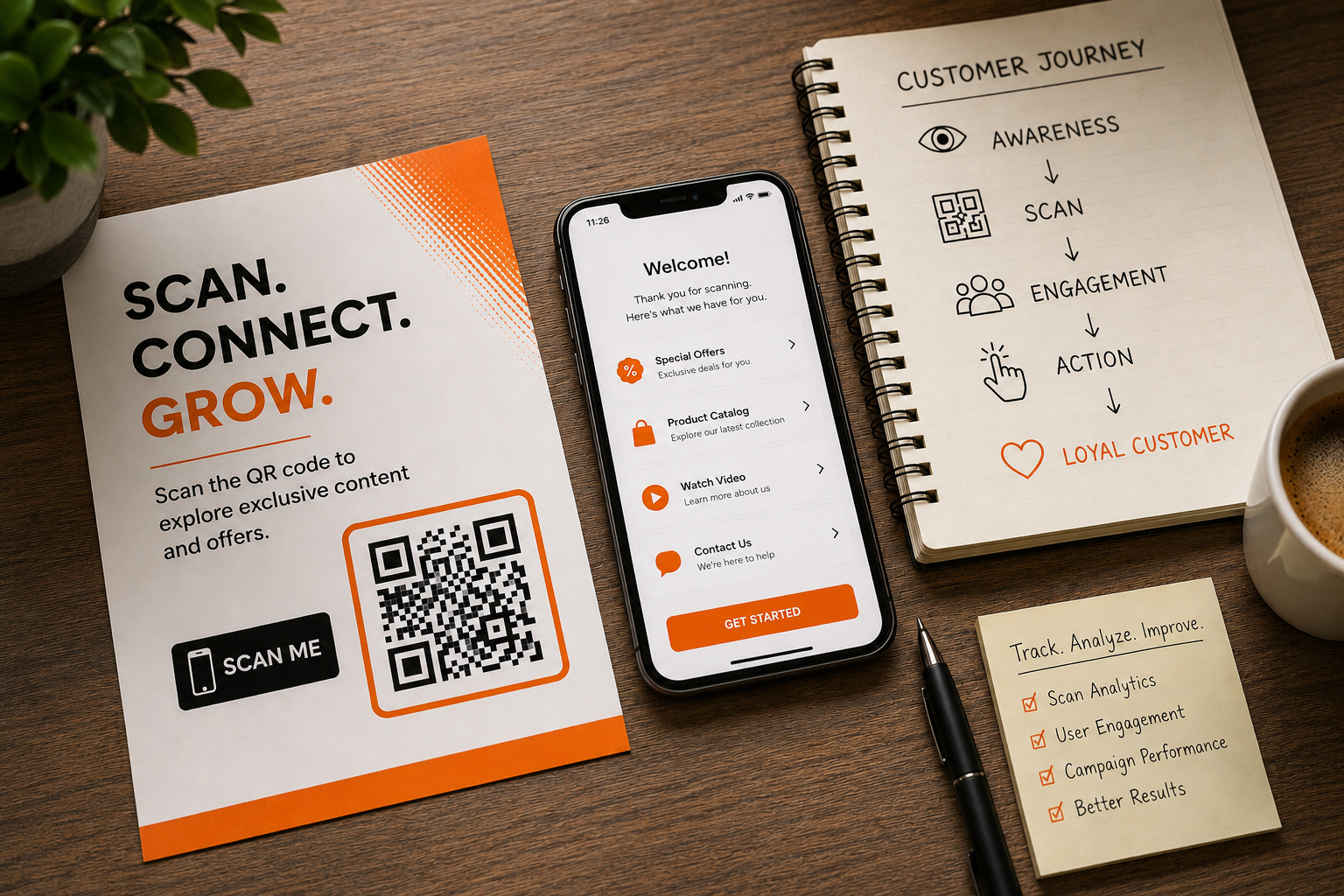
At the awareness stage, a QR code can introduce a business or campaign. During consideration, it can provide detailed information that helps a customer evaluate a product or service. During purchase, it can provide offers, ordering information, booking options, or store details.
After purchase, it can provide instructions, support, warranty registration, feedback forms, or related product information. Later, the same relationship can continue through loyalty programmes, new product announcements, or other digital experiences.
This wider view makes QR marketing more than an advertising tool. It becomes a way of connecting different customer needs through physical touchpoints and digital destinations.
The Destination Matters as Much as the QR Code
A technically perfect QR code can still produce a poor marketing result if the destination is not designed properly. When someone scans a code, they have already taken an action, so the next page should respect that decision by giving them something useful without unnecessary effort.
A customer should not have to navigate through multiple unrelated pages to find what the QR message promised. If the printed message says “Explore the Collection,” the destination should make the collection immediately visible.
If the message says “Book a Visit,” the booking option should be easy to find. If the message says “Get Product Support,” the support information should not be hidden behind several layers of navigation. The quality of the destination directly affects the quality of the journey. Businesses should therefore think about the QR code and its landing experience as one marketing unit rather than as two separate elements.
A Good QR Journey Should Feel Natural
Customers do not think in terms of “QR technology.” They think in terms of what they want to accomplish. This is an important distinction when designing campaigns. A customer does not necessarily care whether a business uses a static QR code, dynamic QR code, or another technical approach.
They care about whether the experience is quick, clear, useful, and relevant. Good QR marketing therefore removes unnecessary complexity from the customer's perspective. The code should be easy to find, the reason for scanning should be understandable, and the destination should deliver on the promise.
When all three parts work together, the QR interaction can feel almost invisible because the customer simply gets what they need. That simplicity is one of the strongest qualities of a successful QR campaign.
Dynamic QR Codes Can Make Campaign Management More Flexible
Marketing campaigns often change. Offers expire, products are updated, events move to new dates, landing pages are redesigned, and businesses launch new promotions.
This creates a challenge when physical marketing materials have already been printed. Dynamic QR codes can provide greater flexibility because the destination associated with the code can be managed without necessarily changing the physical QR graphic.
This can be particularly useful for long-running campaigns or printed assets that remain in circulation for an extended period. A business may print a QR code on packaging or signage and later update the digital experience behind it according to its current marketing needs.
The physical asset can continue to serve as a connection point while the digital content evolves. For marketers, this reduces the need to treat every printed QR campaign as a fixed and unchangeable asset.
QR Codes Can Help Compare Physical Marketing Channels
One of the interesting possibilities of QR marketing is the ability to compare different offline channels through digital interactions. A business may wonder whether its brochure generates more engagement than its showroom signage, or whether a product display creates more digital interest than a printed advertisement.
When campaigns are structured appropriately, QR interactions can provide another layer of information for comparing these touchpoints. This does not mean QR data should be treated as the only measure of campaign success.
Instead, it can become one useful signal alongside sales, enquiries, website activity, customer feedback, and other business metrics. Over time, these signals can help marketers understand where physical marketing is creating the strongest digital response.
This can lead to better decisions about design, placement, messaging, and budget allocation.
The Message Around the QR Code Can Influence Behaviour
The words placed next to a QR code can have a major influence on whether people interact with it. “Scan Me” is simple, but it does not explain the benefit. A more specific call-to-action gives customers a reason to act. For example, “Scan to Explore,” “Scan to Get Details,” “Scan to Book,” “Scan to Save,” or “Scan to Discover More” can create a clearer expectation.
The right message depends on the campaign objective. A business promoting a product should communicate the product-related benefit. An event organizer should communicate the event-related action. A service provider should make the next step clear.
The QR code itself is visually recognizable, but the surrounding message gives it meaning. Good QR marketing therefore combines visual design with clear communication rather than relying on the code alone.
QR Marketing Should Be Designed Around One Clear Objective
A common problem with marketing campaigns is trying to achieve too many things at once. A single QR destination might contain a company introduction, product catalogue, social media links, contact information, multiple offers, a blog, videos, and several other options.
While having information available can be useful, too many choices can make the customer's next step unclear. A stronger approach is to define the primary objective of the particular QR campaign.
If the purpose is product discovery, make product discovery easy. If the purpose is enquiry generation, make the enquiry action prominent. If the purpose is event registration, focus the experience around registration.
Additional information can still be available, but the main journey should remain obvious. This helps customers move through the experience without unnecessary confusion.
Measurement Should Lead to Action
Collecting QR analytics is useful only when businesses actually learn from the information. If one campaign performs better than another, the next question should be why. Was the placement different? Was the audience more relevant? Was the offer stronger? Was the call-to-action clearer? Did the destination provide better information? Was the campaign active during a period when customers were more likely to engage? These questions turn measurement into optimization.
Marketing becomes an ongoing process in which each campaign teaches something about the audience and the environment. QR technology can support this approach because it creates a measurable connection between a physical marketing touchpoint and a digital interaction.
The real benefit comes when businesses use those observations to improve future campaigns rather than simply reporting the number of scans at the end of the month.
Common QR Marketing Mistakes Can Break the Customer Journey
Even a strong campaign concept can fail because of small practical mistakes. A QR code may be printed too small, placed where it is difficult to scan, surrounded by distracting graphics, or presented without a clear call-to-action.
The destination may not work properly on mobile devices, or the page may contain information that does not match the physical advertisement. Another issue is allowing old campaigns to remain active after the information behind them is no longer relevant. Customers who encounter outdated content can lose trust in the brand.
Businesses should therefore test their QR experiences before launch and continue checking important campaigns after they are live. QR marketing is a digital extension of a physical brand experience, so broken links, confusing destinations, and outdated information can affect the customer's overall impression of the business.
QR Codes Can Become Part of a Larger Marketing Ecosystem
The strongest use of QR technology often happens when it is connected to other marketing activities rather than treated as a separate campaign.
A business can use QR codes alongside print advertising, social media, packaging, events, email campaigns, retail displays, websites, and customer support. The QR code becomes one connection point within a larger ecosystem. For example, an offline advertisement can encourage a scan, the QR destination can provide a special digital experience, and that experience can lead to another interaction with the brand. In another situation, a physical product can use a QR code to connect the buyer with support or additional information after purchase.
This creates continuity between different channels. Instead of having isolated marketing experiences, the customer can move naturally between physical and digital environments.
The Future of QR Marketing Is About Better Experiences, Not More Codes
As QR codes become increasingly common, simply having a QR code will not make a campaign stand out. Customers are already familiar with scanning, so the competitive advantage will increasingly come from what happens before and after the scan. Businesses will need to create experiences that are useful, relevant, fast, and connected to a clear purpose.
The question will move from “Do we have a QR code?” to “Does our QR experience help the customer?” That shift is important because technology alone rarely creates a great marketing campaign. The strategy, message, destination, context, and follow-up experience are what give the technology value.
For businesses using QR platforms such as Spur QR, this approach opens the door to creating different types of digital touchpoints for different customer needs.
The platform offers a wide range of QR use cases and supports dynamic QR functionality and analytics-oriented features, allowing businesses to build QR experiences that go beyond simply directing visitors to a generic webpage.
Building a More Measurable QR Strategy
A practical QR marketing strategy does not need to begin with dozens of campaigns. Businesses can start with one physical touchpoint where customer interaction is already happening.
They can define the objective, create a relevant digital destination, add a clear call-to-action, launch the QR experience, and then study how customers interact with it. Once the business understands what works, the approach can be expanded to other locations and campaigns.
This gradual process makes it easier to learn and improve rather than launching many QR codes without knowing what each one is supposed to achieve.
A useful framework is to think about five questions before launching a campaign: Where will the customer encounter the QR code? Why would they scan it? What will they see after scanning? What action should they take? What will the business learn from the interaction? These questions keep the campaign focused on the customer rather than on the technology. They also make it easier for marketing teams to connect QR activity with broader business objectives.
Why Measurable Customer Journeys Matter
Modern marketing is becoming less about individual advertisements and more about understanding how customers move between different interactions. A person might first notice a product in a store, scan information from the packaging, visit a digital page, compare the product with another option, return later, and eventually make a purchase.
Another customer may see an event poster, scan the code, register online, attend the event, and later contact the company. These are customer journeys rather than isolated marketing impressions.
QR codes can provide one of the links connecting those moments. When businesses build campaigns with this journey in mind, they can create more useful experiences and gain a clearer picture of how physical marketing contributes to digital engagement.
Final Thoughts
QR code marketing has evolved beyond the simple idea of placing a scannable square on a piece of printed material. Today, a QR code can serve as a connection point between a physical customer experience and a measurable digital journey.
The most important part is not the scan itself but everything surrounding it: the reason the customer chooses to scan, the context in which the code appears, the quality of the destination, the action that follows, and the information the business can learn from the interaction.
When businesses approach QR marketing strategically, a poster can become an interactive campaign, packaging can become a digital information channel, an event display can become a registration point, a business card can become a complete digital profile, and a physical product experience can continue online.
The QR code simply provides the bridge, but the journey behind that bridge is whern e the real marketing value is created.
The future of QR marketing is therefore not about putting more codes in more places. It is about putting the right experience in the right place for the right customer and understanding what happens after the scan.
Businesses that focus on that complete journey can move from simply generating QR scans to creating meaningful, measurable customer interactions.
With the right strategy and tools, QR codes can become an important part of a connected marketing system—one that brings together physical visibility, digital engagement, customer intent, and measurable campaign performance.