Table of Contents
- Student QR Codes: A Smarter Way to Manage Student Identity and Information
- What Is a Student QR Code?
- Why Student ID Cards Need a Digital Layer
- A Student ID QR Code Can Make Information Easier to Access
- What Information Can Be Included?
- Student QR Codes for Schools
- Student QR Codes for Colleges and Universities
- Student QR Codes and Emergency Information
- Library Management Can Become More Convenient
- Student QR Codes for Campus Events
- Student Photo Support Adds Another Layer of Identification
- Student QR Codes Can Support Modern Campus Operations
- Static or Dynamic Student QR Code?
- Branding the Student QR Code
- How to Create a Student QR Code
- Where Can a Student QR Code Be Used?
- Privacy Should Remain a Priority
- The Future of Student Identification Is More Connected
- Conclusion
Student QR Codes: A Smarter Way to Manage Student Identity and Information
Managing student information has traditionally involved printed ID cards, paper records, spreadsheets, registers, and manual verification. While these methods are familiar, they can become difficult to manage when a school, college, university, or coaching institute has hundreds or thousands of students. A student ID card may contain only basic information such as a name, photograph, roll number, class, and institute name, while important details such as an emergency contact, blood group, phone number, email address, or other information may be stored somewhere else.
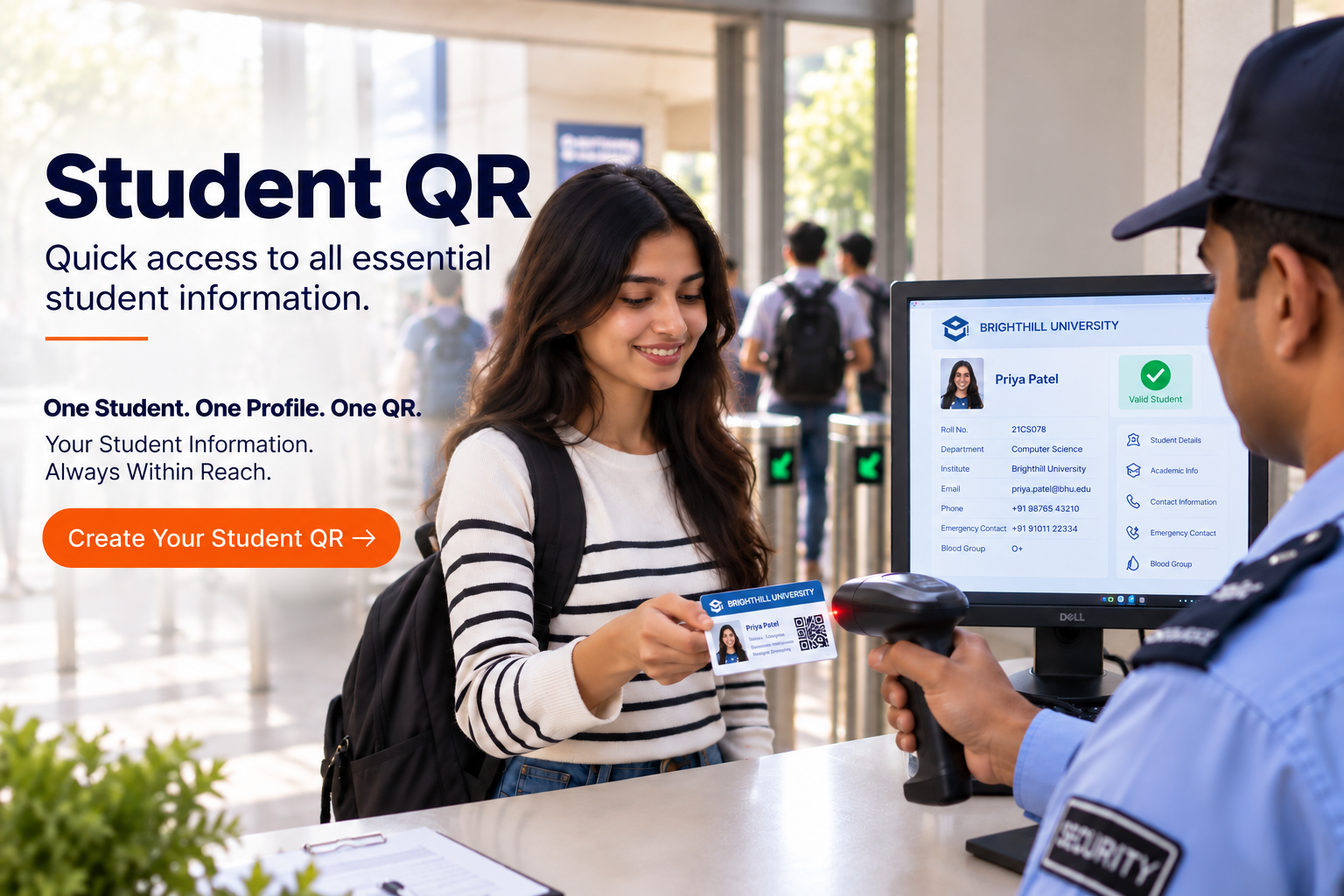
This creates a gap between the student's physical identity and the information an institution may need to access quickly. A Student QR Code provides a simple way to connect these two things. With a QR code placed on a student ID card, the relevant student information can be accessed through a smartphone scan, creating a more convenient digital layer around the traditional student identity card. Spur QR's Student QR Generator is designed specifically for this purpose and supports student information such as student name, roll number, class or year, department, institute, phone, email, emergency contact, blood group, student photo, address, and notes.
What Is a Student QR Code?
A Student QR Code is a scannable QR code created specifically to store or provide access to student-related information. Instead of depending entirely on a printed ID card, an institute can add a QR code that connects the physical student identity card with digital information. When the code is scanned, the person scanning it can access the information associated with that student, depending on how the QR code has been configured. The idea is simple: the student's identity remains visible on the physical card, while the QR code provides a quick digital access point for additional information. Spur QR describes its Student QR Code solution as a way to create a digital student identity that can be used with student ID cards and other campus-related applications. The platform allows institutions to enter academic and contact information and optionally upload a student photograph before generating the QR code.
This approach can be useful because student information is not always limited to academic identification. A student may have a roll number and department for everyday identification, but there can also be situations where contact information or emergency information becomes important. A traditional card may not have enough physical space to display everything clearly. A QR-based student identity can provide a practical way to keep the physical card simple while connecting it to a larger digital information profile. The result is not about replacing the identity card completely; rather, it adds another useful layer to it.
Why Student ID Cards Need a Digital Layer
A student ID card is used for much more than proving that someone belongs to an educational institution. Students may use their IDs to enter campus buildings, attend events, access libraries, participate in activities, or identify themselves to staff members. However, the information printed on the card is usually limited because the card needs to remain small, readable, and convenient to carry.
Imagine a student carrying an ID card that contains their name, photograph, roll number, department, and institute name. This may be enough for ordinary identification, but it does not necessarily provide quick access to an emergency contact or blood group. If these details are stored separately, staff members may need to check another system or contact a specific department. A QR code can provide a direct connection to additional student information.
The Student QR Generator on Spur QR includes fields for emergency contact and blood group along with academic and contact details. It also provides an option for uploading a student photo, allowing the digital student profile to contain information that goes beyond what might comfortably fit on a printed card.
A Student ID QR Code Can Make Information Easier to Access
The biggest advantage of a Student QR Code is convenience. A person does not need to manually type a roll number, search through a long list, or depend entirely on paperwork to access the information associated with a QR-enabled student identity. A smartphone scan can provide the digital information connected to the code.
For educational institutions, this can be particularly useful when many students are moving through the same environment. Staff members at an entrance, event desk, library, or administrative area may need to verify student information quickly. A QR code provides a simple interaction: scan the code and access the information available through it.
This can also help students themselves. Their ID card becomes more useful because it can act as a connection to a broader digital profile instead of being only a printed identification document.
The concept can be summarized in a simple way:
- Student ID card → QR scan → Digital student information
- Student identity → Academic details → Contact and emergency information
The purpose is not to make the process complicated. It is to make commonly needed information easier to reach.
What Information Can Be Included?
One important feature of a Student QR Code system is the ability to organize different types of student information in one place. Spur QR's Student QR Generator includes fields for the student's name, roll number, class or year, department, institute, phone number, email, emergency contact, and blood group. The platform also supports a student photo and additional information such as address and notes.
This creates more possibilities than simply putting a student's name inside a QR code. An institution can build a more complete student information profile while keeping the physical ID card clean and easy to read.
For example, a student profile might contain:
- Basic identity: Student name, photograph, roll number, class or year, and department.
- Institution information: Institute name and other relevant academic details.
- Communication details: Phone number and email address.
- Emergency information: Emergency contact and blood group.
- Additional information: Address and notes where appropriate.
The exact information an institution chooses to include should depend on its operational requirements and its privacy and access policies. Not every field needs to be displayed or made available to every person who scans a QR code.
Student QR Codes for Schools
Schools can use QR-enabled student IDs to create a more organized approach to student identification. In a school environment, students may move between classrooms, activity areas, libraries, laboratories, events, and entrances throughout the day. Teachers and administrative staff frequently need to identify students, and having a digital information layer can make certain processes easier.
A QR code can be printed on the student's existing ID card without changing the basic appearance of the card. The student's name, photograph, school name, and other important identification details can remain visible in the traditional format, while the QR code provides an additional digital connection.
For schools with large numbers of students, this can also provide a consistent format. Instead of creating completely different identification methods for different classes or departments, the same basic QR workflow can be used across the institution.
Student QR Codes for Colleges and Universities
Colleges and universities can benefit from the same concept on a larger scale. Higher-education campuses often have multiple departments, courses, buildings, libraries, laboratories, events, clubs, and administrative offices. Students may need to interact with several different areas during their academic journey.
A Student QR Code can become part of a broader campus identity system. For example, a student ID card with a QR code can be scanned when the student needs to provide identification at an event, access a library service, or verify student information.
Spur QR specifically lists campus access, library management, emergency response, and event registration among potential use cases for Student QR Codes.
The important advantage is that the QR code can support different situations without requiring a student to carry several separate cards or documents.
Student QR Codes and Emergency Information
Student safety is one area where having the right information available quickly can matter. A student ID card may show the student's name and photograph, but emergency information is often kept separately. Spur QR's Student QR Generator includes dedicated fields for emergency contact and blood group.
Consider a situation where a student needs assistance on campus and staff members need to identify the student and find the appropriate contact information. A QR-enabled ID can provide a quick route to the information that the institution has chosen to associate with that student.
This does not mean every piece of personal information should automatically be exposed to anyone who scans the code. Educational institutions should carefully decide what information is appropriate to make accessible, who should have access, and how student privacy should be maintained. The technology is most useful when it is combined with sensible information-management policies.
Library Management Can Become More Convenient
Libraries are another area where student identification is frequently required. Students may borrow books, return materials, register for services, or interact with library staff. Traditional processes often involve manually entering student numbers or searching for student records.
A QR-enabled student ID can provide a faster identification step. The library staff member can scan the student's QR code and access the information required for the particular process.
Spur QR identifies library management as one of the use cases for Student QR Codes, specifically describing scanning student QR codes as a way to support book checkout without manual entry.
The real benefit here is consistency. Students already carry their IDs, so the QR code does not require them to carry an additional device or document.
Student QR Codes for Campus Events
Educational institutions conduct many events throughout the year, including seminars, workshops, competitions, cultural programs, orientation sessions, conferences, and student activities. Managing attendance manually at these events can take time, especially when many students arrive at once.
A QR-enabled student ID can provide another way to identify participants. Students can present their ID, the code can be scanned, and the institution can use the associated information for the event process.
Spur QR lists event registration as a Student QR Code use case and describes student QR codes being used for instant check-in at campus events.
For institutions that already conduct regular events, this can help create a more organized experience without requiring students to remember separate registration details every time.
Student Photo Support Adds Another Layer of Identification
A name and roll number can be useful, but adding a photograph can make identification easier. Spur QR's Student QR Generator allows an institution or user to upload a student photo as part of the student profile.
This can be particularly useful in environments where multiple students have similar names. The photograph provides an additional visual reference and can help staff confirm that the digital profile corresponds to the correct student.
When combined with the student's academic information, the profile becomes more recognizable. Instead of relying on a single identifier, the institution can use several pieces of information together.
Student QR Codes Can Support Modern Campus Operations
Digital transformation does not always require replacing an entire system. Sometimes the most useful improvement is adding a small digital feature to a process that already works. Student QR Codes are an example of this approach.
Schools and colleges do not necessarily need to abandon their existing ID cards. A QR code can simply be added to the card. The institution can continue using the physical card for everyday identification while the QR code provides access to additional information.
This makes the transition easier because students do not have to learn an entirely new identification process. The familiar ID card remains in their hands, but it becomes more useful.
Static or Dynamic Student QR Code?
When creating a QR code, institutions may need to consider whether a static or dynamic QR code is more appropriate. Spur QR's Student QR Generator provides both static and dynamic options, with login required for dynamic QR functionality.
A static QR code contains fixed information and is useful when the information does not need to be changed after generation. A dynamic QR code can provide more flexibility when the destination or information needs to be updated.
This difference matters for educational institutions because student information can change. A student may move to another academic year, change departments, or have updated contact information. If the institution requires the QR destination to remain adaptable, a dynamic approach may be more suitable.
The right choice depends on how the institution intends to manage student records and how frequently information needs to change.
Branding the Student QR Code
Student identification is also connected to institutional branding. Schools and colleges often have recognizable logos, colors, and visual styles that appear on ID cards, certificates, websites, and other materials.
Spur QR allows QR codes to be customized with patterns, colors, corner styles, backgrounds, and logos.
This means an institution can create a QR code that visually fits its existing identity rather than using a completely generic design. However, customization should always be balanced with readability and reliable scanning. A QR code should remain easy for smartphone cameras to recognize.
The best design is usually one that looks professional while keeping the QR code clear and functional.
How to Create a Student QR Code
Creating a Student QR Code does not need to be a complicated process. Spur QR provides a step-by-step workflow where the user enters the student's information, adds additional contact or emergency details, optionally uploads a photograph, and then generates the QR code.
The basic process is:
- Enter student details such as name, roll number, class or year, department, and institute.
- Add contact and emergency information, including phone, email, emergency contact, and blood group where appropriate.
- Upload the student photo if required.
- Generate the QR code.
- Add the QR code to the student ID card or another appropriate student identification material.
The simplicity of this process is important because an education-focused solution needs to work for administrators and staff who may be managing information for many students.
Where Can a Student QR Code Be Used?
A QR-enabled student identity does not have to be limited to one particular location. Once created, the code can be incorporated into different student-related workflows depending on the institution's needs.
Potential applications include:
- Student ID cards
- Campus entry and access
- Library identification
- Event check-in
- Student information verification
- Emergency information access
- Academic or departmental identification
Spur QR's own Student QR page highlights student ID cards, campus access, library management, emergency response, and event registration as key use cases.
This flexibility makes the QR code useful as a supporting layer rather than a single-purpose technology.
Privacy Should Remain a Priority
When technology is used to handle student information, convenience should never come at the cost of responsible data handling. A QR code can make information easier to access, but institutions should carefully consider what information is appropriate to include and who should be able to view it.
Information such as emergency contacts and blood groups can be useful in the right situation, but they are also personal details. Schools, colleges, and universities should establish clear policies around how student data is collected, stored, accessed, and shared.
The goal should be simple: make necessary information accessible to the right people without unnecessarily exposing information to everyone.
This is especially important when QR codes are printed on physical ID cards that students may carry outside the campus environment. Before deployment, institutions should test the complete scanning experience and decide what information should be visible through the QR code.
The Future of Student Identification Is More Connected
Student identification is gradually moving beyond a simple printed name and photograph. As educational institutions look for more efficient ways to manage campus operations, digital tools can help connect identification, information, and everyday processes.
A Student QR Code provides a relatively simple starting point. It does not require students to carry another device, and it can be added to the ID cards they already use. The QR code simply creates a bridge between the physical card and digital information.
For schools, colleges, coaching institutes, and other educational organizations, this can create opportunities to simplify identification, improve access to relevant information, and make certain campus processes more convenient.
Conclusion
A Student QR Code is more than just a QR pattern printed on an ID card. It can become a practical connection between a student's physical identity and digital information. With the right setup, a QR-enabled student ID can provide access to academic details, contact information, emergency contact information, blood group, student photographs, addresses, and other relevant details. Spur QR's Student QR Generator is built around these requirements and provides fields for student identity, academic information, contact details, emergency information, photo support, and additional notes.
For schools and colleges, the value comes from making existing processes easier rather than making technology complicated. A student can continue carrying a familiar ID card, while the QR code gives staff and authorized users a convenient way to access the information connected to it. The same QR code can potentially support campus access, library workflows, event check-ins, and emergency information.
The most important part is to implement it thoughtfully. Choose the information that genuinely needs to be available, maintain appropriate privacy controls, test the QR code before distributing it, and create a design that fits naturally into the institution's existing ID card.
A student ID card identifies the student. A well-designed Student QR Code can make the information behind that identity easier to reach.